AI amplifies our strengths and offers the possibility of gradually outsourcing the act of doing. The machine researches, codes, calculates, and produces in our stead, delivering results without us having to undergo the process that leads to them. This replacement fuels fantasies of labor market disruption, built on promises of the progressive obsolescence of human action.
But what we risk with AI is not only the loss of jobs; it is the loss of the experience of "doing"—the set of impulses and gestures that give meaning to our lives and our place in the world. And it is the technology's own proponents who say it best.
Doing is overrated
One of them, the founder of a startup that generates albums for Spotify, explains that “it’s not really a pleasure to make music anymore today. It takes a lot of time. You have to practice a lot (...) I think most people don’t enjoy most of the time they spend making music” (M. Shulman).
For 40,000 years, we have been making music "the hard way," with instruments that are difficult to play. It takes years to get a sound out of a flute, a lifetime to master a genre. But that is precisely what "making music" is. Searching, copying, repeating, interpreting, quoting. All of this allows the musician (even an amateur) to get to know themselves by participating in a collective history.
“Doing anything" is an opportunity to place oneself at the heart of the world, to enhance what is most human within us. We “do” things and, along the way, we come to know the world and its meaning; we understand our place within it. On the contrary, “we do not obtain knowledge by standing outside the world; we know only because we are of the world. We are part of the world and participate in its different becomings” (K. Barad, 2007).
We must "strategize" technology
What a privilege we have to be able to "do"! Watch yourself create: all that it implies—and how much it involves you! AI offers us an unprecedented opportunity to rid ourselves of this privilege, in order to focus solely on the product of the action. This tragedy is called the "functionalization of the world." In a functionalized company (efficient because it produces, but where no one actually does anything anymore), your teams will not involve themselves. They will not engage; they will lose the pride of having "done," and the benchmarks of their place in your project will fade away.
The implementation of AI in organizations is therefore not a matter of technology. It is a cultural matter that touches upon power (what can I still do?), pride (what can I tell myself and others that I have done?), meaning (why was this done?), and identity (who am I, the one who has done this?). We have "technologized" every layer of the company, right down to the strategy. We must now rethink the way the deployment of our technologies impacts corporate culture: we must "strategize" technology (D. Djaïz).
This means: ceasing to be subjected to the tool and instead putting it at the service of a vision (no longer asking ourselves "what can this technology do?" but "what do we need?"); consciously deciding which areas to sanctuaries for humans (judgment, creativity, relationships) and which to delegate; and refusing blind optimization to prevent the logic of the machine and those who sell it (speed, division, exploitation) from dictating the organization of work and emptying the spirit of the company.
3 rules for effectively deploying AI
The deployment of AI is a total organizational transformation. But as early as 1983, L. Bainbridge warned: “by taking away the easy parts of their task, automation can make the difficult parts of the human operator’s task more difficult.” The more automated the system, the more crucial the human becomes in guaranteeing its quality, even as they lose the ability to understand the results they obtain and the skill necessary to intervene. Ironically, after a certain time, we will no longer be in a position to judge the quality of AI production, having delegated the "doing" to it—yet it is the "doing" that feeds the "judging."
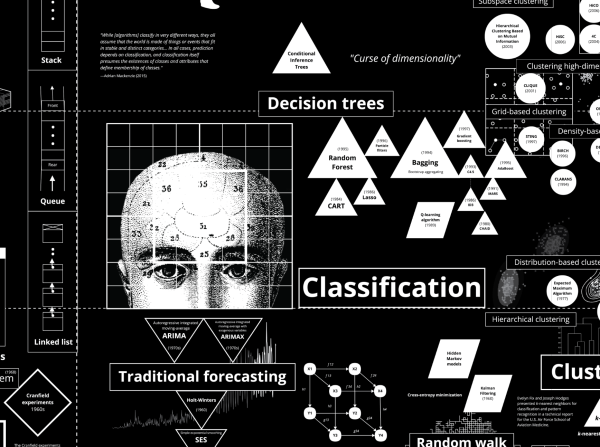
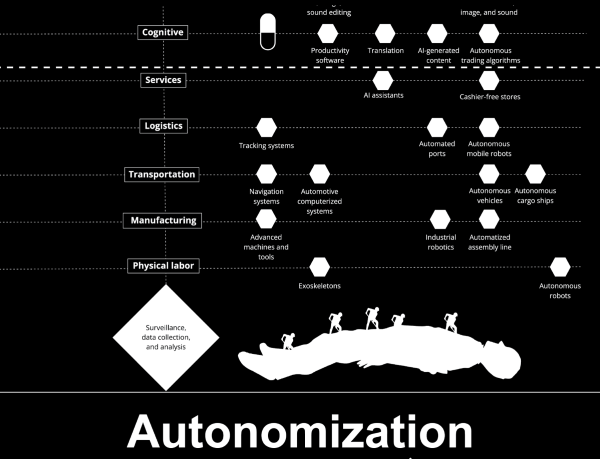
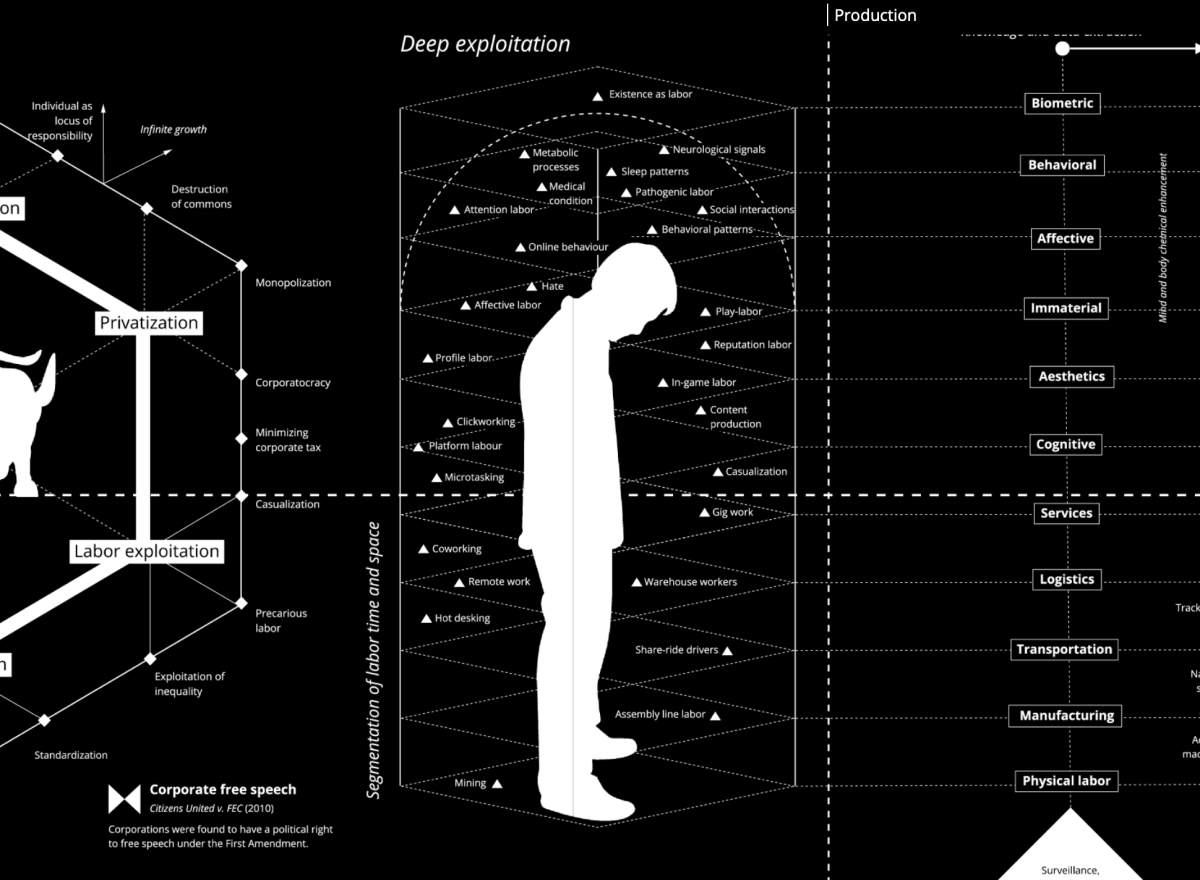
Against these threats, we recommend—as do K. Crawford and V. Joler (authors of the monumental genealogy of technology and the exercise of power since 1500)—that you take your time. A radical act in a period of acceleration and simplification, but one that will distinguish those who have delegated the soul of their company from those who have preserved it. 3 rules guide this preservation and the effective deployment of AI:
- Nurturing critical skills: maintaining regular practice to preserve an intimate understanding of processes (writing, analyzing, synthesizing).
- Remaining alert: as errors become rarer in an increasing synthetic output, we struggle to distinguish them. We must redouble our critical vigilance.
- Sharpening our discernment: we inherit the errors of the system's designers (biases, hallucinations, etc.), and lack the means to understand their causes. The true assets for unlocking the full potential of AI are judgment, subtlety, and a profound understanding of the human context.
AI increases and will continue to increase labor productivity. But without these rules, this new productivity will not lead to economic growth or better living conditions. By eroding the sense of agency that employees have over their environment, it will destroy their engagement, preventing the company from executing its strategy. Because humans do not "do" simply to produce; we "do" to multiply the ways in which we belong to the world. Take that away, and nothing remains. Create new ways, augment them through technology, and you will finally have a company of a new kind.